


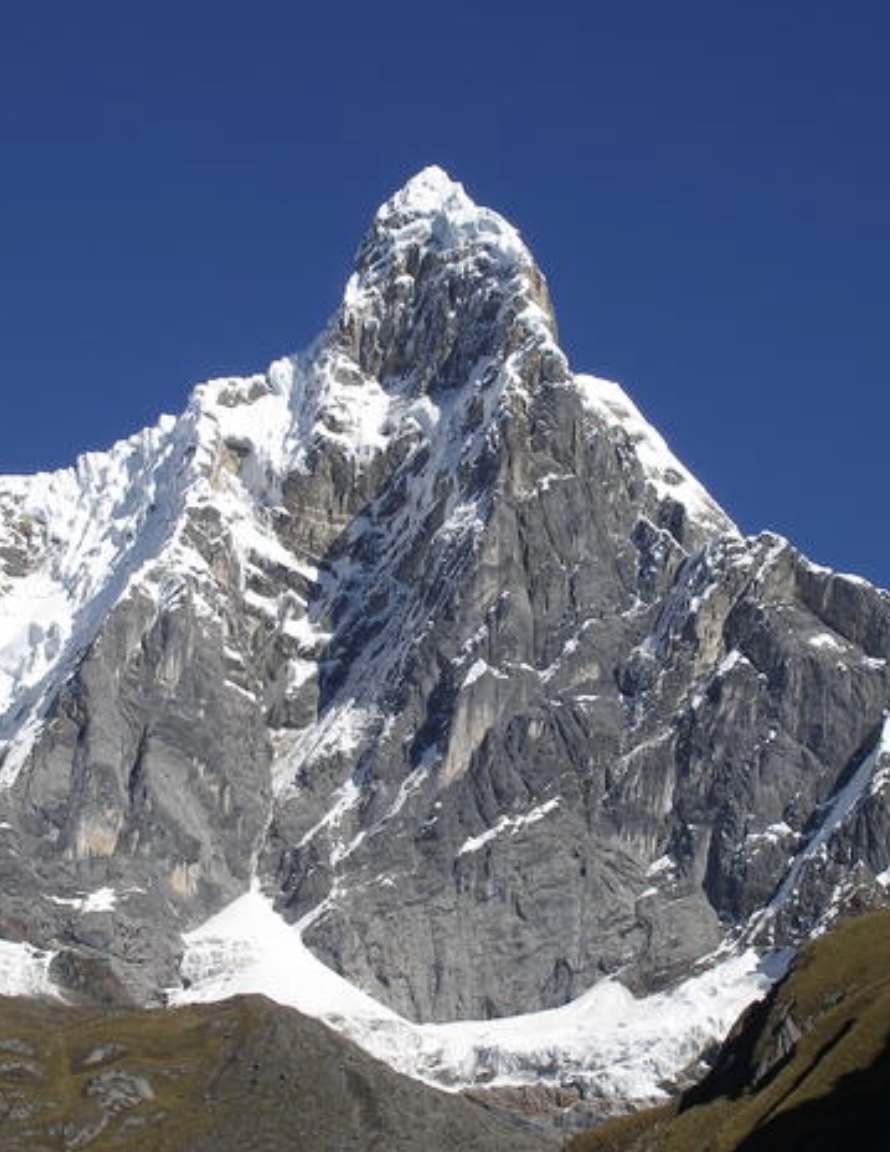
One of the things I love about bouldering is that it's harder to cheat than it is in almost any other facet of the sport. Honestly, I don't really care about peoples' personal style of ascent that much anymore, but I do care about how continual shortcutting affects them personally. I think that holding ourselves to a high standard is essential to success in the long term, and I think that shortcutting or not shortcutting is a habit.
There was a recent controversy where a strong team of climbers did a route on Jirishanca in Peru but stopped at the "east summit," which, it appears, is not the top of anything, really. Far be it from me to tell climbers that are far out on the edge what they should be doing, but I have to wonder if the east summit really was part of the plan, or if somewhere inside they really would have liked to summit the mountain.
In sport climbing these days, there's an epidemic of "The Colorado Toprope," where a climber will use a stick clip not just to protect the first hard and dangerous moves by clipping the first bolt of a route, but will clip through the highest bolt that can be reached with today's very long sticks. Again, to each his own, but one has to wonder if skipping two or three hard clips on a route is really doing it in the intended style of lead climbing. If it’s not an issue of safety, then it’s only an issue of trying to make things easier.
Much like stopping at the east summit (I've had my fair share of east summits in my life), stick clipping the fourth or fifth bolt is fine, as long as you fully own that behavior. If your intention is to do the route in a clearly lesser style, do so. But don't consider your style equal to that of someone who goes to the top or does the route as intended.
Another example in the news recently is the Pete Hegseth pull-up. In a now infamous video, the US Secretary of War does a whole bunch of what he calls "pull-ups" as a way of showing how fit he is. The problem is that these pull-ups don't feature the very hardest part of the exercise. It would be like running the middle 30 seconds of a 4 minute mile. Ladies and gentlemen, I can tell most of what I need to know about a person from watching them do pull-ups. John Wooden reminds us, “the way you do one thing is the way you do everything.”
Ownership of behaviors is not really a "training" type of thing, but I think that the gym is a great place to practice it.Rollins said, "the iron doesn't lie." Nor do boulders.
I've said this a hundred times before: planning is fun. The key to planning for most of us? Restraint. If we're going to truly succeed in our training we'd better be sure we have what it takes to do the training. Otherwise, we have to hear that voice. The one that reminds us we fell short. The one who reminds us that we talk more than we act. The one who warns us against announcing what we're going to do next.
Character is fundamental to long-term athletic success. Sure, you can be the best on your team. You can win comps. You can even be a real jerk and climb very hard routes. But the cracks begin to show. Of course, full-on cheating or lying is probably going to bite you in the end. More importantly for most of us is that cheating or taking it easy on a micro-scale erodes character, too. Cutting a run short. Doing four sets of pull-ups instead of five. Leaving work early because we’re bored of the work.
I read an essay a few years back where it was suggested that we live our life as if everything we did that day would be published in a newspaper feature the next day. All the things you said. All you did. Sort of like the Black Mirror episode "Joan is Awful."
"Steve rolled his eyes when he saw the incoming call was Alex."
"Steve only did five of the planned eight reps."
"One again, Steve had to transfer half of his to-do list to tomorrow."
I feel like there is nothing more satisfying in work than completing a job well. Nothing that feels better in training than holding the correct intensity and duration for the intended result. Nothing better in climbing than knowing you did the route in good style, without trying to make it easier on yourself than others before you did.
What was the conversation that led up to stopping at the East Summit? What's so wrong with doing the very hard technical climbing below and saying, "Hey, we just didn't feel like going to the top was that important." What's wrong with just saying, "Man, Action Direct is a hard route, and I just didn't have what it takes." How about, "I'm only going to do five pull-ups per set in the next few workouts."
It starts with this next move. The next set. If you can't do it, own that, and attack the limiter. Don't pretend that limiter doesn't exist.