


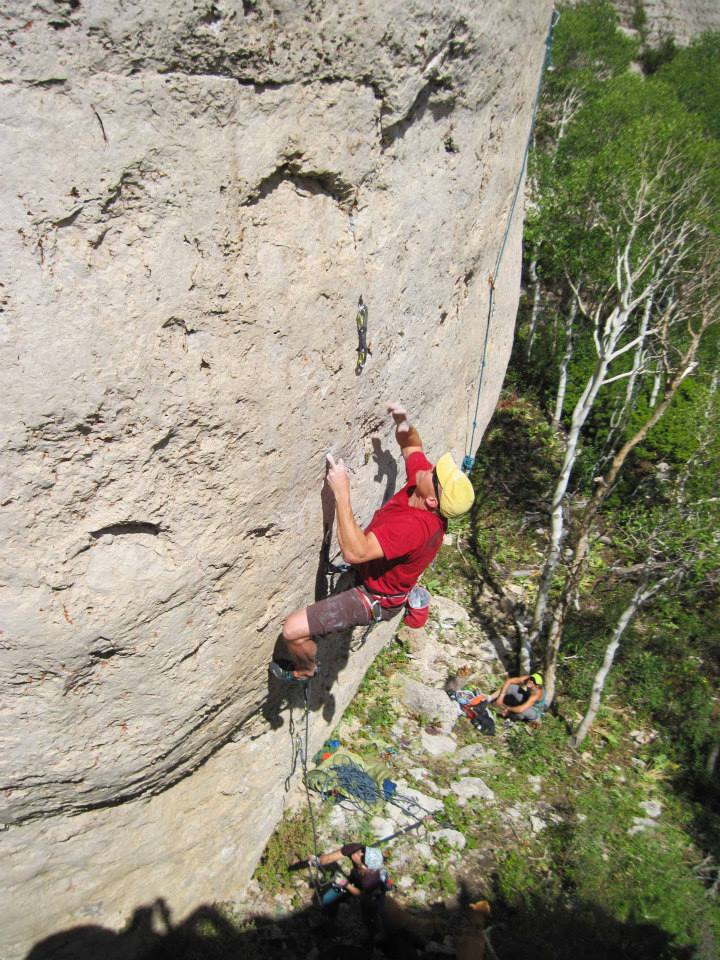
“The first step off a peak is down.”
I remember long seasons of chaining together send after send. It sometimes felt like I’d work a route one day, send the next, and just repeat. When I was in my early 20s, I spent a winter in Railay and it seemed like I redpointed hard routes for weeks on end. I then flew home, started working 2 days a week at a climbing store, and climbed most other days, sending my hardest routes ever, for months.
That memory messes with me. I remember only the feeling of getting solid at new grades, of grabbing a new best-ever a couple of times, and feeling strong and fit the whole time. Only on reflection can I now see why I had more than half a year of peak performance—I wasn’t peaking at all.
I had built up to a high volume of climbing, often getting 30 or more pitches in per week, and on most days, I’d try a route that would take me a few tries to send. Then I’d do another and another at the grade until I’d done maybe 20 and then the next grade started coming easy. It was an accidental good progression brought on by wanting to climb anything and everything in the area. Nothing was all that hard to sort out even as I advanced through the grades. I was, despite what felt like high performance, “climbing medium.”
In the years that followed, I continued to climb the grade ladder, but the overall volume of routes I did started to drop. I started trying routes that would take a week, ones where I had to train for the crux boulder, others where I needed to build fitness to fight fatigue. At one point, I spent a couple of seasons trying to sort out how to get strong for a low boulder on a pitch but then have the stamina for a lifetime-hardest pumpfest above. When I finally did send, I felt like I had finally reached the big time and leveled up to the next tier of performance. It didn’t take even one more climbing day to sort out that I had done a great job of getting very fit for a specific objective. And that it would be almost a year before I sent anything near that hard again.
This is where we, as climbers, need to make a choice. We can build a high level of volume and get a lot of pretty hard climbs done. Alternatively, we can get really strong, find a climb near our limit, and perfect all the parts of our climbing in order to send. Neither is the right choice, and each path has its place. The only issue is when we believe we can do both.
There are the tail ends of the spectrum on either side of these choices, too. These are traps that are easy to fall into, and they appear when we let our fear or ego drive our decisions. At the very low end, we have “eternal base-building,” where a climber will continue to rack up easy pitch after easy pitch, often on toprope, in order to feel fit enough to try harder things. This never happens, so never try this tactic. As a marker, remember that if you can send 4 routes of a grade in a week’s time, it’s time to move on to harder stuff.
On the top end, we have the “eternal project,” which is its own kind of hiding place. This one is a max or supermax-level route that the climber comes back to year after year, building micro progresses in the mind, but generally getting dug into doing only the very familiar and getting very out of condition for anything else. Yes, there are many climbers who will engage with one hard route over several years, but the successful ones also climb other things in the meantime.
For most climbers to find success, they need to do capacity work, but make sure it’s technically challenging—or they need to push hard on a limit route, but be sure it is in the realm of do-able.
Wise programming almost always has a mix of capacity-focused work and intensity-focused work throughout the year.
There are a thousand ways to set this up, and it can get complicated in a hurry. Instead of cracking open a massive spreadsheet, let’s just keep a few rules in mind.
Rule 1. Training Requires Progress
We throw around the term “training,” but training is a special thing. Sometimes we can boulder and get better. Sometimes we can open an exercise app, follow along, and get a little stronger. But anyone who has been at it for more than a few months starts to see these “easy” wins taper off. Training, by definition, is about improving at a specific thing. In conditioning the body for sport, training is about overload.
Whether your goal is more capacity or more intensity, you need to aim for progress in each session. If I can do three sets of three pull-ups in my first session, I need to up the ante next time. Add a 1 pound weight to a belt. Do another rep or set. Slow the movement down. And this needs to happen throughout a training cycle.
The process of training requires that we tell our body, “you’re not good enough, yet.”
Rule 2. Capacity Can Be Painful…In More Ways Than We Think
Sometimes people miss out on the secret of endurance, and that’s the fact that endurance takes both time and a willingness to suffer. When we want to build capacity, the prescription always includes dedicating more time to the effort. The difficulty in building effective endurance or general capacity plans is that the first sessions should be easier than you think and then continue to progress until the last sessions feel intolerably difficult. This requires us to do 8-12 progressive sessions over several weeks…a thing that I believe most climbers have never done.
It’s boring. It’s arduous. It’s about more than just muscular endurance.
I tell the story occasionally about recommending a “Route 4x4” workout to a couple of 5.13 level climbers, and suggesting they start by doing the workout at the 5.9 or 5.10a level. (For those unfamiliar with this workout, it involves athlete one leading a pitch, then quickly lowering and toproping it three more times. The athletes then switch, and athlete 2 does the same. This sequence is repeated three more times, with a day-end total of 16 pitches per athlete.)
I just so happened to arrive at the crag the first day these two decided to try the session, and they had decided my recommendations were a bit soft. Instead, the two decided to start with a pumpy 11c. By the second lap on the first climb, I could see that they were in trouble. Of course they didn’t finish the session. They didn’t even finish the first set. They certainly did not progress into 7-11 more sessions of progressively harder difficulty.
Add more time at low intensity. Progress carefully. The first three or four sessions should feel a bit too easy, the final three or four should feel like a real reach.
Rule 3. If You’re Doing It Right, You’ll Eventually Run Out Of Gas
Some climbers will want to continue to add more and more boulder sessions or endurance sessions or whatever to a program. If you’re overloading, though, you’ll start to feel the plateau building, the power failing, the grind really getting to you. This means you’re doing it right.
It’s not a failure. On the contrary, a climber that gets to the end of a training phase that needs a break from the training is probably on target.
Finish the planned workouts as best you can that last week, and know that a break is both needed and recommended.
Rule 4. Step Off, Don’t Fall Off
Once you hit the end of your ability to go harder, acknowledge that. Look at the progress you made from sessions one to session ten or twelve. Be happy with the progress, and then take some time.
The simplest way to program for this is to aim for a recovery week every fourth or fifth week. This week should be around half the volume of your previous training week, and at a lower level of difficulty. This is a great time to do some other sports, to get out and check out a new area, or to simply climb for fun on routes you’d typically ignore.
After a good week or ten days, you can start in again on another cycle that builds on top of the previous one.
If you are having long cycles of good performance, as I did all those years ago, that’s great. But understand that you might be leaving some amount of performance on the table. A little more focus on trying harder things will see your fitness fluctuate more, but will also see you topping harder climbs.
Remember that training works. The best training coaxes us to slightly better performances, it doesn’t try to whip us into quick shape. Be patient but be persistent. Tomorrow’s session won’t be amazing, but if you do it right, the one thirty days from now will delight you.