


Having an impressive range of motion is highly desired but rarely pursued with the same focus as our finger or pull strength. I think it’s because gaining great flexibility matches Steve’s adage about endurance perfectly; it’s really fun to have but very boring to get. I’m on the more flexible end of the bell curve, but I have never been able to do a full side split or pancake fold despite the fact that I do mobility work consistently within my training. A few years ago I got really serious about improving my mobility with a goal of trying to get a full side split. In the past few years I’ve made some great progress and along the way I’ve gathered a few general lessons and tools I have found most helpful.
Lesson 1 – Give gravity some assistance.
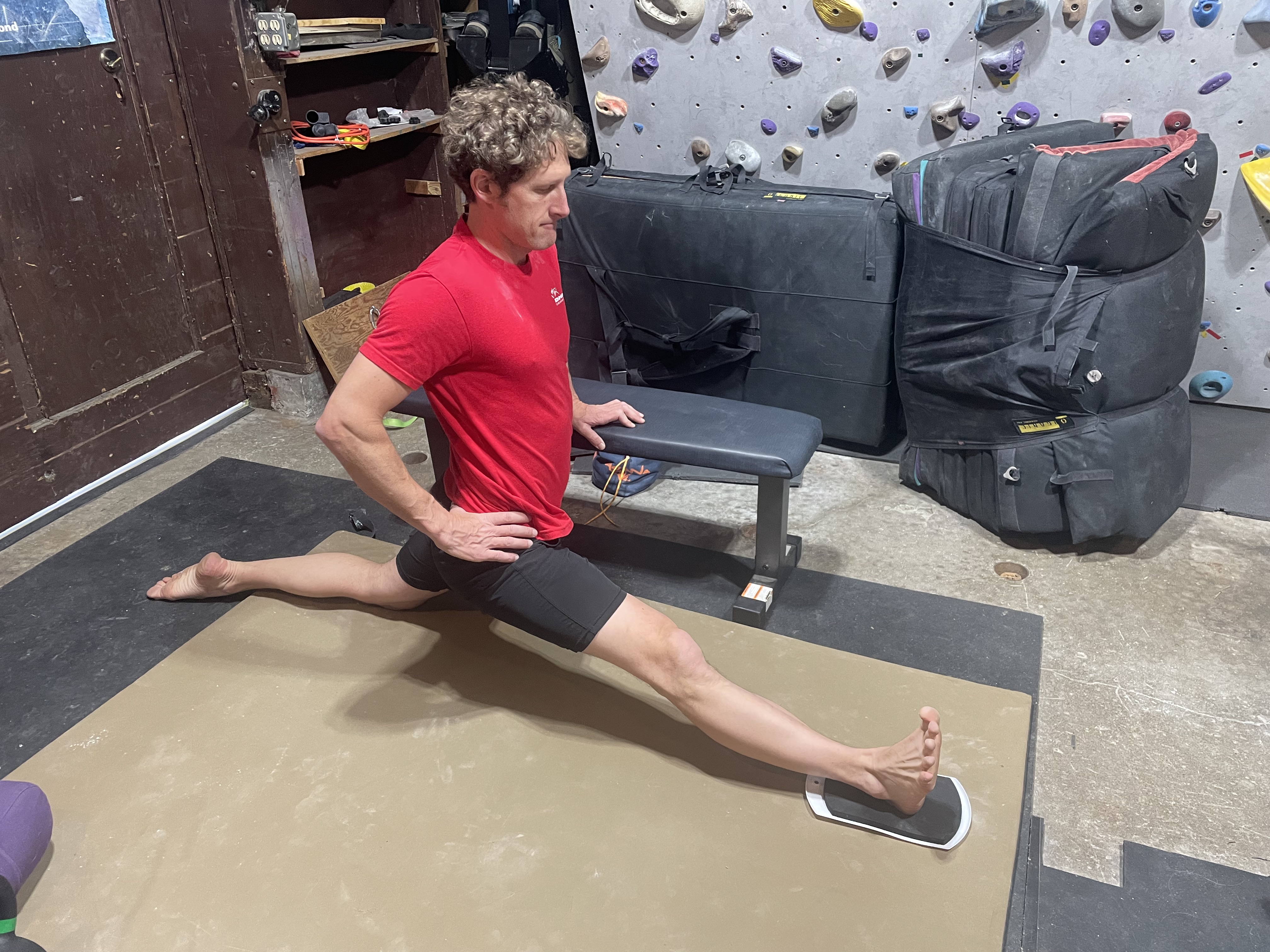
Use furniture sliders and weights to increase the load. The way most stretches are performed gravity is the primary force being used to lengthen the muscles. This works better for some stretches than others. Let’s use the frog stretch as an example. This one is frequently used to open up the hips, but I find two problems with this. Often the friction between our legs and the surface we are on is great enough to make it difficult to get deep enough to overload this position. Second, that friction makes training the antagonist muscles by lifting out impossible. So get yourself a set of the largest furniture sliders you can and put them under your knees. Now you will easily slide into your deepest position and likely find even a bit more range. The resistance will be so minimal that you abductors can pull you into a deeper stretch assisted by gravity and your adductors can now be trained by pulling you inwards. You are now doing reps instead of static holds. I like to do a few reps to warm up to my near max range. Then I do three sets of 8 reps with a 3-10 second count at the bottom. This helps me track my volume and know I am spending enough time gain comfort in the new range.

What about the butterfly, how do we assist gravity here? Grab two 10# weights and place one on each knee. If you are stiff enough this will likely do nothing on its own, but if you pair that assistance with strength in your hips you can pull your knees to the floor much easier than if unassisted. A good metric to aim for is the ability to get your knees to the floor with just the strength of your hips. If you can’t do that then add the minimum weight needed to get there. When trying to gain new ranges of motion our brain needs to know we are strong enough to be safe in this new range so I try to find a method that uses muscular tension to get into the stretch when possible as opposed to a purely passive approach. Almost every stretch uses gravity to some extent, figure out how best to assist gravity and you’ll be pushing deeper sooner than expected. For a dirt bag solution use full water bottles instead of weights and paper plates instead of furniture sliders.
Lesson 2 - Get comfortable, use yoga bolsters to help you relax.
There are many things that can limit our ability to get into deeper ranges of motion. One of the main ones being neurological limiters that are trying to protect us by resisting going deeper into a range of motion. When the above methods don’t seem to work anymore we need to find a way to tell the brain to relax and that we are safe. Often this requires really long duration holds at the deepest position. These positions are frequently uncomfortable and awkward to maintain. The best way I have found to do this is by using yoga bolsters. If you are unfamiliar, a yoga bolster is a long and narrow cushion used to prop up the body off the floor for us who were born with less elastin in our muscles. They prop us and support your body in your lowest positions enough that we can comfortably stay there for really long durations. They are easy to stack and help your body to be supported in strenuous stretching positions.
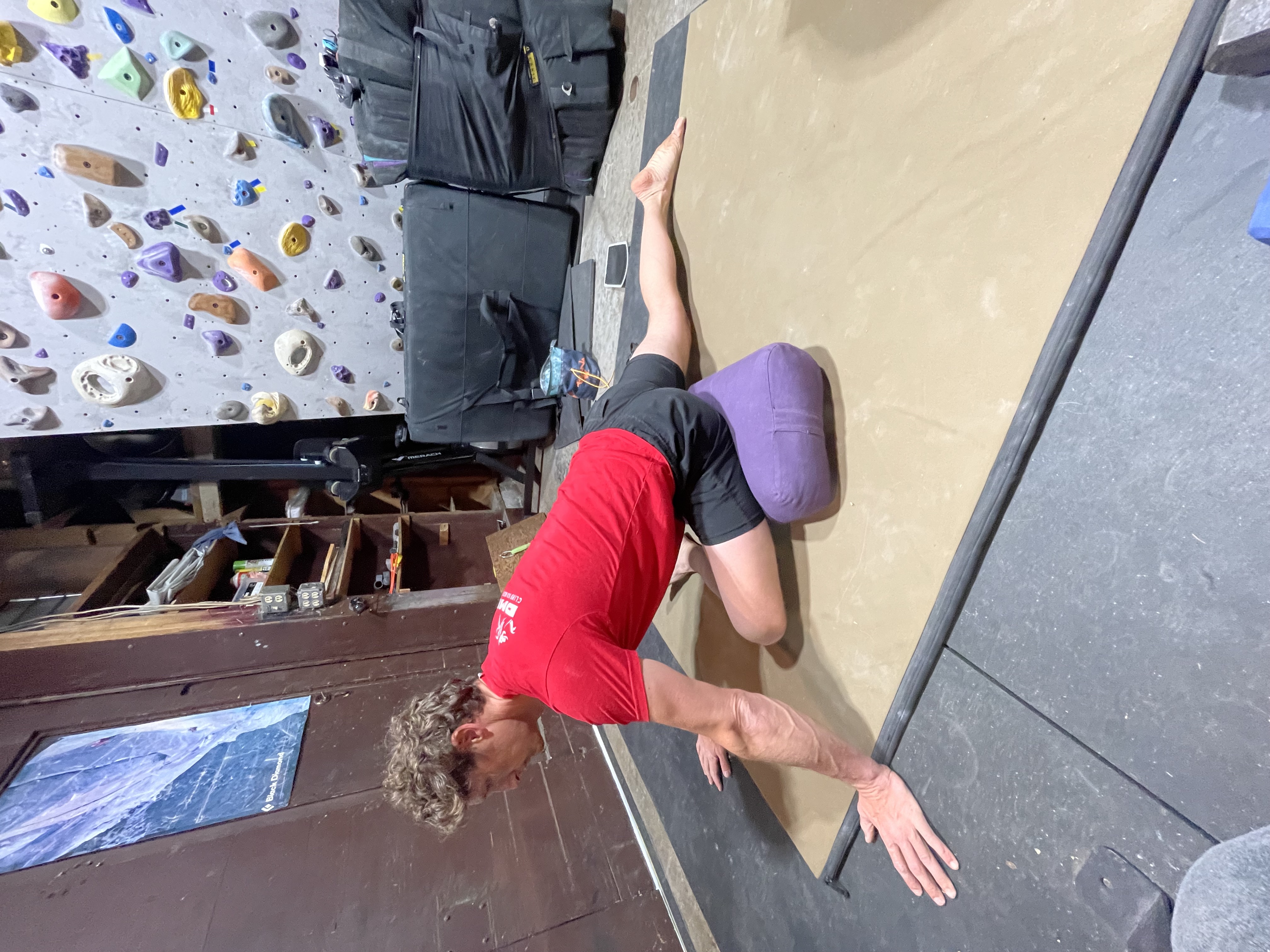
For an example let’s take the pigeon pose. This is another common stretch that I see many people (myself included) have trouble with. I find most people are more limited by their back leg in this stretch. This leads them to compromise the position of the front leg and then neither of them get much out of this stretch. Put a yoga bolster (or maybe two) under your hips, parallel to the front leg. This will allow your hips to stay square and upright. Relax into the position, occasional doing and isometric contraction of the antagonist muscles to lift and then lower deeper. Fold forward for several breaths, and then lift back up for several breaths. The cushion will allow you to sink deeper as your muscles release. With the support of the cushion you can comfortably stay here for a long time. Switch sides and when you do your 2nd set, try smaller yoga bolsters…they come in many sizes.
I have been using this method with my side splits in combination with my furniture sliders. When I started two large bolsters felt maximal. Now I use two to warm up and reduce down to just a single small one. I am likely just a few inches from the floor. When I am in this deepest position I focus on maintaining a relaxed breath while I periodically use muscle contractions to lift and release deeper. The goal is to safely and comfortably explore my total range, what can feel scary at the start begins to feel familiar towards the end. This is just one use of bolsters, they can also be used to add hyperextension if you are very flexible. As an alternative to yoga bolsters you can use pillows, they are a bit too soft and don’t stack well but they are free if you already own them.
Lesson 3 - Track your range—Use yoga blocks or books to monitor progress.
When we go into the weight room we keep track of everything we do. How many sets and reps of each lift we do and weights we were lifting. We also take notes about if we need to increase the load next time or change to a new lift variation. This is pretty standard and it would be considered odd if you were lifting a few times a week but completely unaware of what you did or how much you could lift. I took detailed notes during most of my training, then get on a mat to do my mobility and base it entirely on vibes. Did it “feel” like I was getting a stretch or not, is all the tracking I did. Once I started measuring things my training got interesting.
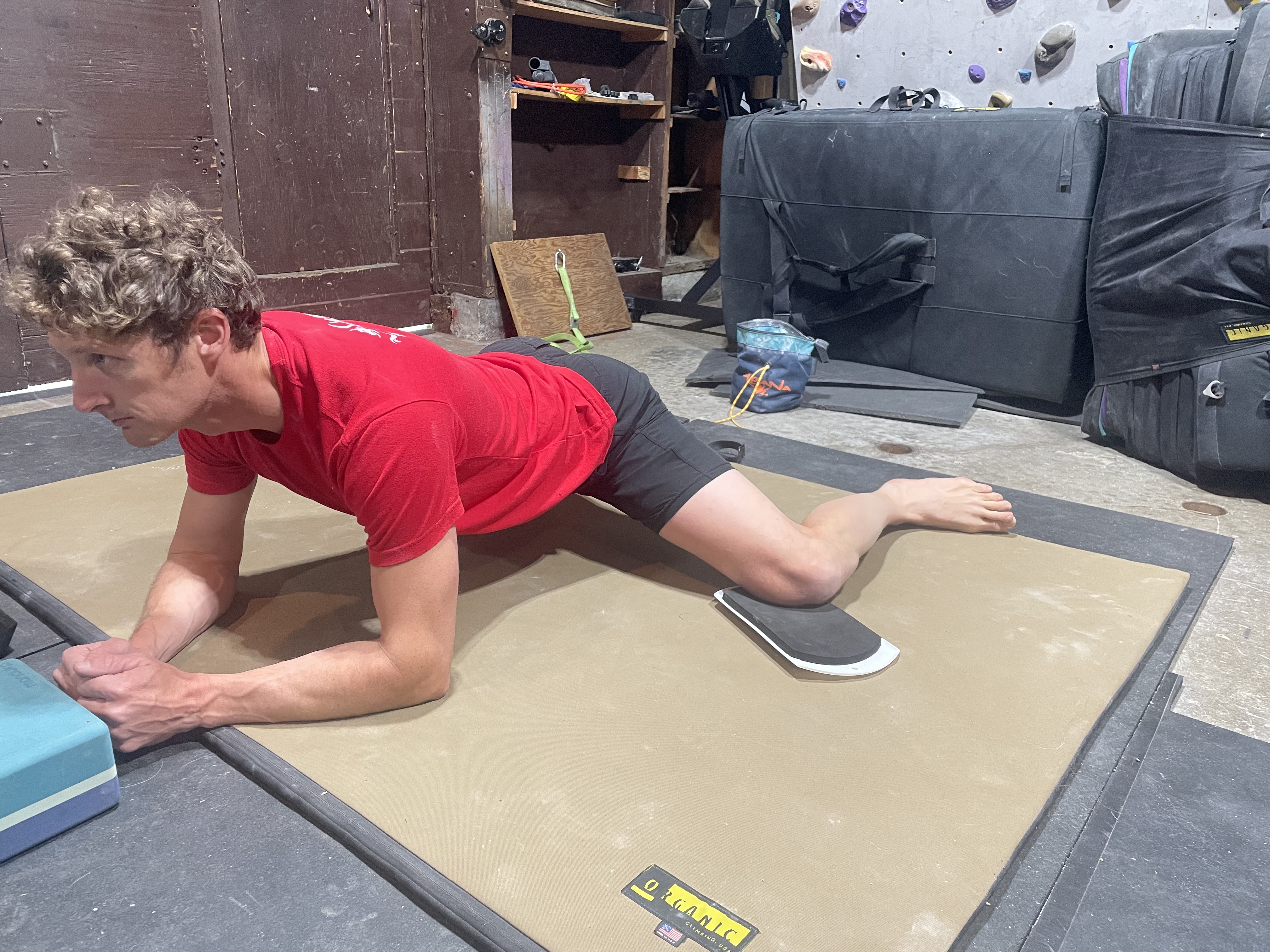
You can measure things in a few ways but lets look at a standard forward fold as an example. Touching your toes is a really good initial goal for many people. If you have no way to monitor your progress it is easy to feel like you're never making progress. But if you add a yoga block between your feet you now have three different height progressions to reach for before you even get to toes. Once you can touch your toes now you can progress to stacking blocks and trying to touch them with your head. Now you have a goal, ideally you will find a distance to reach that you just barely cannot achieve, soon you can touch it with a bit of momentum, then you can touch and hold it, then it becomes part of your warm up. You can easily sub the yoga block for a stack of books; just find some way to track your distance that is easily repeatable and scalable to push your progress. It helps dramatically to improve your motivation.
This is far from a comprehensive description of a mobility plan, but hopefully it will add new ways to bring some focus and performance to your mobility work. The best time to get serious about your mobility training was 5 years ago, the second best time is now.