


Ready, Set, Train…Getting Ready for Winter Training
Most of us ramp up to training with some amount of reluctance. If we had it our way, October would be ten weeks long and crisp and cool the whole time. But at some point the pockets start dripping or the approach gets snowed in or our fitness just slips away. And so we start visiting the gym again and hope that just doing more of what we did last year will finally work this time.
I say that the goal of training is to improve. If you improved last year, your training was probably pretty good. If you didn't, it's time to get your notebook out and start sketching up a plan.
Weekly Calendar
Hope is not a strategy.
I remember the first time I read Schwarzenegger's Encyclopedia of Modern Bodybuilding. I didn't even want to be a bodybuilder and I was inspired to schedule lifting 10 sessions each week. I mapped out each day's workouts, the sets, reps, loads…and then I realized I had to work, too. And train for climbing. And have a life.
The problem with inspiration is that inspiration is rarely pragmatic. Our dreams don't usually feature a lot of to-do lists and what ifs.
So when we start to plan out the training season of our lives, a good place to start is with the simple question, "When am I going to do this?"
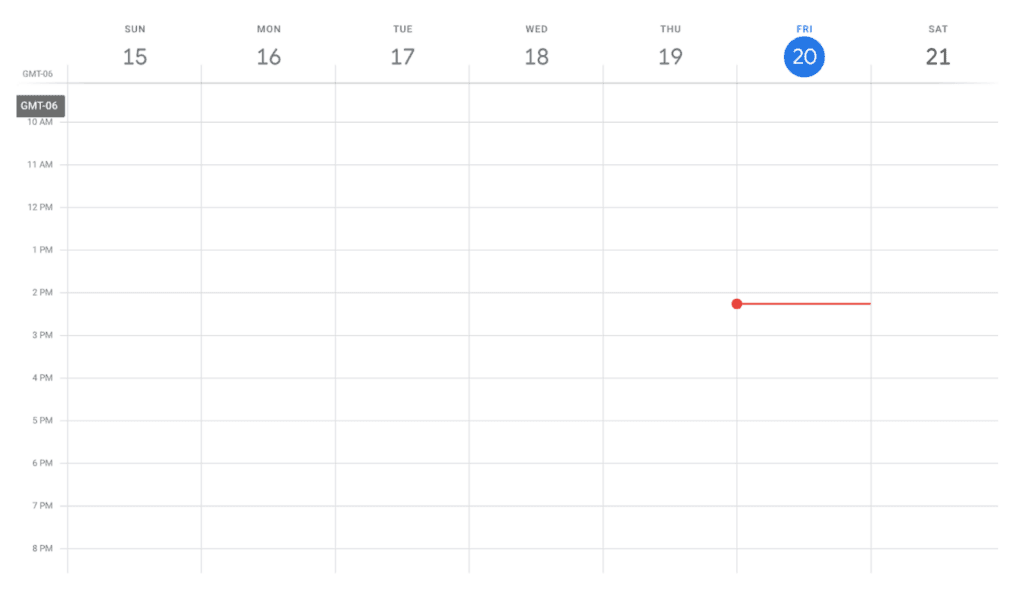
I like to start with a weekly column calendar, like you'd see in your Google Calendar Week View.
To me, it's important to print this out, even if it already includes a bunch of work stuff and other commitments. Once you have this printed out, then we go to work with the pencil. The more you can do this stuff by hand, I think the more latitude you'll give yourself to be creative with your plan. If it's in my Google Calendar, it sort of feels like I am breaking the law when I change things.
The first task is to sketch out when / where / how long you'd like to train each day. Where does it fit in the calendar? What does your commute look like? Will you have the required energy to train during that time?
A second consideration beyond the practicality of the schedule is to look at what you did last year. How many hours did you work out each week? How long were the sessions? What worked well?
With these two pieces of information, we can then start to construct the basement level of our winter plan. We will know when and how much training we can do, and can then build it into the calendar. It's really not a good idea to double your training time at the front end…as much as we hope we'll be super fit and psyched, most of us can't move the needle all that much at the beginning of the season. At most you should plan 20% more volume than last year.
If you can't seem to find the hours, you can get creative. Can I fit in a short session at home? Could I do dawn patrol on a weekend morning? Could I restructure a session or two to be more efficient with my time?
Ten Things To Work On
Once you know when you're going to train, the next step is to sort out what kind of training to do. You can get assessed by a coach or online service, but this will immediately direct you into over-focusing on physical training outcomes. You'll probably ignore the mental, tactical, and movement gains you could make. Instead, I suggest you dig deep into your performance last season and look at where you came up short.
This is a good place to ask a trusted partner, "Hey, if you were me, what would you focus on improving before next season?" You can also look at how you performed on different types of climbing, or even dig into the types of climbs you avoid.
Get your training log out, turn to a blank page, and write out a list of the top ten things you need to improve or want to learn. It might look like this:
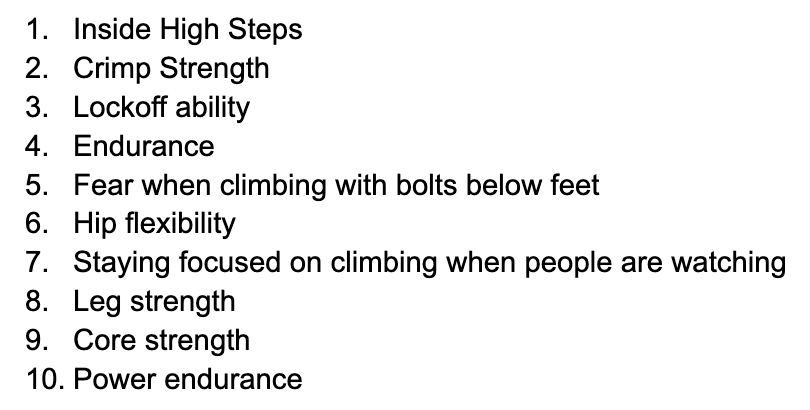
Most of us have lists like this going in our heads all the time, and they tend to shift slightly with different projects and seasons. The problem is that many of these things are really big changes and they take more than "reactive" work for a couple of weeks. Oh, and they can take a lot of time.
The next step is crucial to your success this winter, so don't ignore it. In fact, you can ignore everything else in this article and almost everything else you read if you get this one thing right.
Cross off eight of the items.
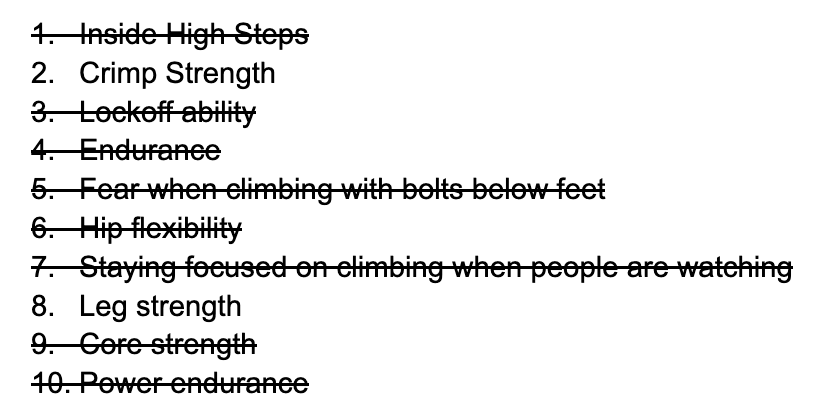
This seems crazy and you may feel you'll fall behind in your climbing and Steve is an idiot and has no idea what I need. But if you've been in the sport for any length of time, you'll need to really focus to see progress in any one facet. And don't worry, if you follow the 75/25 principle (75% of your training should be done on the rock/wall) , you're not going to lose anything in any of the core climbing skills.
So, this year, all of your off-season focus will be on leg strength and crimp strength. These will form the foundation of your off-wall workouts, and getting measurably stronger here is your main goal.
Building Out Cycles
Plan on a 4-week cycle. This roughly lines up with the month, and it's a good period of time to stay focused on building strength or conditioning in a series of sessions. Some of us would rather just go in and boulder every Tuesday and Thursday until March. Fine. Check back when that stops working.
For the rest of us, working on a few specific things for 8-10 sessions will produce good results. You don't need to go crazy, but plan on a couple of days where the main goal is to improve on your stated limiters from above.
We should also strive to get better at bouldering or climbing during the off season, which doesn't always equate with just projecting hard stuff. An effective bouldering improvement cycle might involve any of the following elements (or several others):
- Working on onsighting problems with an aim of improving overall onsight grade.
- Building up total weekly capacity for boulders (track number of boulders in a week's time) with the idea of having the ability to chase higher grades later in the winter.
- Working on your in-a-day max level, rather than just going to limit problems.
- Working on getting a high average performance grade across several move types and angles, and then zeroing in on weaknesses.
An effective training week within a 4-week block, then, might look like this:
M: Crimp and Leg Strength / short capacity boulder
T: Hard Boulder, In-A-Day probs
W: rest
T: Crimp and Leg Strength / Hard Boulder, In-A-Day probs
F: Long capacity boulder
S: rest
S: Routes at gym, onsight tries
Execute and Adjust
We need to do the training, make an objective assessment of how the training is going and then to make adjustments to the plan. When we are doing a training program of any kind, the first marker of success is avoiding injury in the training. If you are 4 weeks into a program and your shoulder is getting achy, adjustments are needed.
Four weeks into training, or approximately the end of your first series sessions, you might not be performing profoundly better on boulders. In fact, if you're getting way better, it's probably the fact that you are just "getting it" and climbing better…good job. However, you should feel a bit stronger on your exercises, notice that you can do more total work per session, and probably have a bit more energy.
Even if things are going great in the training, sometimes we still make adjustments. One of the traps of training is falling into a routine of "same session every day." Let's say you're super successful with bouldering for an hour followed by a short weight session. We might, for sake of keeping things fresh, simply flip-flop the two sections of the session for the next month.
Once we've assessed and adjusted a couple of times, we get pretty good at it. This will happen every month of your training, and after a few seasons, you'll probably get to where you do some quick adjustments monthly and then a big semi-annual review of the trajectory. Oh, and don't forget to actually get out there and go hard when the time comes!
Review, 2 hours, Once Per Quarter
Every 3 months, I get out the training log and a spreadsheet, and put down some numbers. This should include:
- Total exercise duration per week
- Total number of sessions
- Type of sessions
- Climbing performance during the phase (# of boulders/routes, and grades)
- Testing data (i.e. did you get a new in-a-day level?
We also want to look at whether we made improvements in the facets of training we were trying to improve? In our example above, did we get stronger legs? Did we get stronger fingers?
And in the bouldering gym, did my climbing improve in the way that I had aimed my training? We very likely won't see our max grade go up in any 4 week period, but are the building blocks coming together?
The final part of the review is your impression of how the training went.
Did it feel like the volume was correct?
Did you start to feel any overuse?
Did you like it?
What would you do if you could re-do this last quarter?
What do you want to make happen in the next quarter?
If It Ain't Broke
You know the saying…
It is important to assess whether your training is really working. If you keep getting better and sending harder, make any changes to your training very slight. If, however, you're hung up at the same grade you were last year, start digging deeper.
Remember, training happens over long cycles and results in performance improvements. You can go to the gym and get throttled and be sore for months on end, and not get better in the performance environment. This is called exercise. You are an athlete. You need to do more than exercise. You need to train, and training is more than sweat and failure.
Not sure where to begin?
We have training plans available for any level athlete!

ABOUT STEVE BECHTEL
Steve is the founder of Climb Strong, and is proud to be the worst coach on the Climb Strong team. A climber for nearly 40 years, he has traveled the globe bouldering, sport climbing, and doing first ascents of some of the world's biggest walls.
He lives in Lander, Wyoming, with his wife Ellen, and children Sam and Anabel.